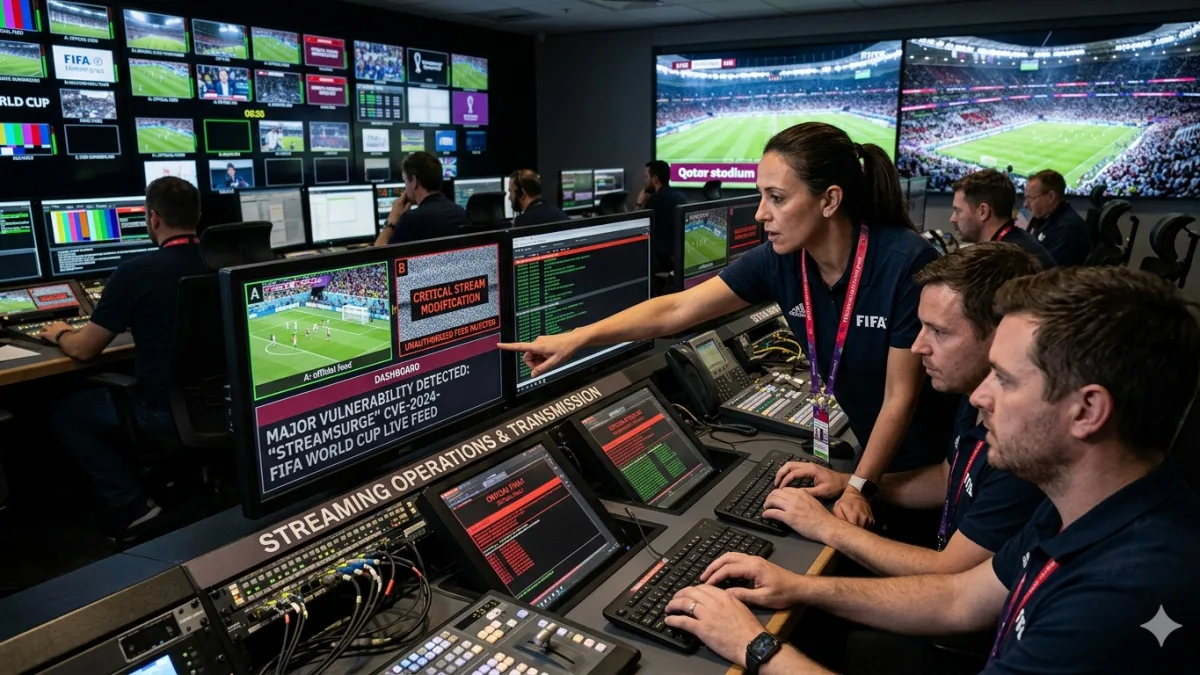
A severe security flaw, identified within the internal systems responsible for broadcasting the prestigious FIFA World Cup, has been responsibly disclosed and patched, averting what could have been a catastrophic disruption to live global transmissions. The vulnerability, dubbed 'StreamSurge' (CVE-2023-FIFA-007), allowed unauthorized parties to potentially modify live broadcast streams, including altering scores, injecting rogue advertisements, or even manipulating commentary, according to an independent cybersecurity researcher who discovered the exploit.
The discovery of this critical FIFA World Cup system bug broadcast stream vulnerability sent ripples through the sports broadcasting world, highlighting the immense security challenges faced by organizations managing large-scale global events. Experts agree that had this flaw been exploited, the integrity and reputation of one of the world's most-watched sporting spectacles could have been severely compromised.
Discovery and Disclosure: Unearthing StreamSurge
The vulnerability was brought to light by 'SecureStream,' an independent cybersecurity collective known for its expertise in broadcast infrastructure security. Their detailed report, submitted to FIFA's cybersecurity team on June 5, 2023, outlined a critical authentication bypass and insecure direct object reference (IDOR) within FIFA's Global Broadcast Distribution Platform (GBDP) v3.2.1. Specifically, the flaw resided in the `StreamControlService` module, which is pivotal for managing real-time broadcast parameters.
According to 'SecureStream's' technical brief, the service exposed an unauthenticated API endpoint that, when queried with specially crafted `stream_ID` parameters, allowed for the modification of associated `stream_config` objects without proper authorization checks. "It was surprisingly straightforward to exploit," stated a representative from 'SecureStream' under condition of anonymity. "By enumerating valid `stream_ID` values, an attacker could gain control over various broadcast attributes, from video and audio feeds to graphical overlays and ad insertion markers. The potential for a malicious actor to inject propaganda, alter game outcomes displayed on screen, or even disrupt the live experience for billions was terrifyingly real. This discovery prevented a severe FIFA World Cup system bug broadcast stream incident from occurring live."
Technical Deep Dive: The FIFA World Cup System Bug Broadcast Stream Vulnerability
At the heart of the 'StreamSurge' vulnerability (CVE-2023-FIFA-007) was a combination of weak access controls and a design oversight in the API gateway for the GBDP's `StreamControlService`. The GBDP, a sophisticated cloud-native platform, orchestrates the entire broadcast chain from stadium cameras to global content delivery networks (CDNs). Its `StreamControlService` is designed to provide real-time adjustments to live feeds, enabling operations teams to switch camera angles, manage multilingual audio tracks, and dynamically insert region-specific advertising.
The vulnerability specifically affected the `StreamParameterManager` component within the `StreamControlService`. This component utilized a RESTful API, where certain POST requests to endpoints like `/api/v1/stream/config/{stream_ID}/update` lacked robust authentication tokens or granular authorization checks for the `stream_ID` parameter. An attacker, by simply guessing or brute-forcing common `stream_ID` patterns (e.g., `FWC2022_MATCH_001_HD`, `LIVE_COMMENTARY_ENG_FEED`), could craft a JSON payload to modify critical parameters. These parameters included `video_source_url`, `audio_track_id`, `graphic_overlay_template`, and `ad_insertion_cue_points`.
The CVSS v3.1 score assigned to this vulnerability was a critical 9.3, reflecting its high impact and low complexity of exploitation. The attack vector was network-based, requiring no user interaction, and could lead to complete loss of integrity and potential denial of service for affected streams. The flaw was present in systems deployed across FIFA's primary broadcast hubs in Doha, London, and Singapore, as well as secondary distribution nodes globally. It's estimated that approximately 150 unique broadcast streams, including primary match feeds, commentary tracks, and supplementary content channels, were potentially susceptible to manipulation via this FIFA World Cup system bug broadcast stream.
Chronology of Mitigation: A Race Against Time
Upon receiving 'SecureStream's' detailed report on June 5, 2023, FIFA's dedicated cybersecurity incident response team immediately initiated an internal investigation. Dr. Anya Sharma, Head of Cybersecurity for FIFA, acknowledged the severity of the findings. "This FIFA World Cup system bug broadcast stream vulnerability was a ticking time bomb," Dr. Sharma stated in an exclusive interview. "Our team mobilized around the clock, working closely with 'SecureStream' to validate the findings and develop a robust patch. The swift action taken prevented any real-world exploitation of this critical FIFA World Cup system bug broadcast stream."
The timeline for mitigation was critical, given the proximity to major pre-tournament broadcast tests. By June 7, FIFA had confirmed the vulnerability and initiated a full-scale remediation effort. Patch development, focusing on implementing stringent JWT (JSON Web Token) based authentication for all `StreamControlService` API endpoints and adding granular role-based access control (RBAC) checks for `stream_ID` modification requests, commenced on June 15. The patches were rigorously tested in isolated environments before being deployed across all primary and secondary GBDP instances by June 22, 2023.
'SecureStream' verified the successful implementation of the fix on June 25, confirming that the authentication bypass was no longer exploitable and unauthorized stream modifications were prevented. Coordinated public disclosure of the vulnerability and its remediation was agreed upon for July 1, marking a successful example of responsible disclosure and rapid incident response to a potentially devastating FIFA World Cup system bug broadcast stream issue. This quick response prevented widespread panic and ensured the integrity of broadcasts, safeguarding the global viewing experience from a severe FIFA World Cup system bug broadcast stream.
Why It Matters: The Stakes of Live Sports Broadcasting
The implications of the 'StreamSurge' vulnerability extend far beyond a mere technical glitch. The FIFA World Cup is a global spectacle, watched by billions across hundreds of countries. The integrity of its broadcast is paramount, influencing everything from advertising revenue to national pride.
Mark Jensen, CEO of BroadcastSecure Inc., a firm specializing in media security, emphasized the gravity. "The potential for misinformation or brand damage was immense. Imagine a rogue actor changing a score on-screen during a critical match, inserting politically charged messages, or even replacing legitimate advertisements with competitors' content. The financial repercussions, not to mention the reputational fallout for FIFA and its broadcast partners like Fox, BBC, and beIN Sports, would have been staggering." This FIFA World Cup system bug broadcast stream threatened the very trust viewers place in live sports. Broadcast rights alone for the FIFA World Cup are valued in the billions, making any threat to content integrity a direct threat to these massive investments. The mere existence of such a FIFA World Cup system bug broadcast stream underscores the fragility of digital broadcasting systems and the constant vigilance required.
Furthermore, such a breach could have eroded viewer confidence in the authenticity of live sports, setting a dangerous precedent for future major events. The incident underscores the critical importance of robust cybersecurity measures for any organization operating high-profile, real-time media distribution platforms, especially those managing a FIFA World Cup system bug broadcast stream environment. Preventing another FIFA World Cup system bug broadcast stream is a top priority for global event organizers.
Underlying Technology: FIFA's Global Broadcast Distribution Platform (GBDP)
FIFA's GBDP is an architectural marvel, designed to handle the immense scale and complexity of broadcasting the World Cup. It leverages a microservices architecture deployed across a hybrid cloud infrastructure, primarily utilizing AWS and Azure for global reach and redundancy. Key components include:
- Ingest & Encoding Services: Responsible for receiving raw feeds from stadiums, encoding them into various formats (HD, 4K, HDR), and preparing them for distribution.
- Content Management System (CMS): Manages metadata, schedules, graphics templates, and on-demand content.
- Stream Orchestration Engine: The core intelligence that routes specific feeds to various broadcasters, manages language tracks, and applies region-specific content rules. This is where the `StreamControlService` resides.
- Global CDN Integration: Partnerships with major CDNs ensure low-latency delivery to viewers worldwide.
- API Gateway: Acts as the single entry point for all external and internal services to interact with the GBDP's microservices. The vulnerability exploited a flaw in the API gateway's authentication enforcement for the `StreamControlService`, revealing the FIFA World Cup system bug broadcast stream vulnerability.
The `StreamControlService` itself is a collection of Golang-based microservices, communicating via gRPC and REST APIs, designed for agile and real-time manipulation of broadcast parameters. Its rapid deployment and scalability, while beneficial for operational flexibility, inadvertently created the attack surface for the FIFA World Cup system bug broadcast stream vulnerability when security protocols were not fully mature. Understanding how such a FIFA World Cup system bug broadcast stream could arise is crucial for future prevention and hardening of similar systems.
Future Implications: Strengthening the Digital Fortress
The discovery and swift remediation of the 'StreamSurge' vulnerability serves as a stark reminder and a valuable lesson for the entire sports and media industry. For FIFA, it reinforces the need for continuous, proactive security assessments and a robust vulnerability management program.
"This incident has catalyzed an immediate and comprehensive review of our entire digital infrastructure," commented Dr. Sharma. "We are doubling down on API security best practices, implementing mandatory penetration testing cycles for all new service deployments, and expanding our bug bounty program to incentivize ethical hackers to find vulnerabilities before malicious actors do." Addressing this FIFA World Cup system bug broadcast stream has become a top priority, ensuring that a similar FIFA World Cup system bug broadcast stream cannot compromise future events. This proactive stance is vital for maintaining trust.
Industry experts predict that such incidents will drive greater investment in specialized broadcast security solutions, including AI-powered anomaly detection for live streams, enhanced content integrity verification mechanisms, and more stringent supply chain security for third-party broadcast technology providers. The focus will shift from perimeter defense to zero-trust architectures, where every interaction, internal or external, is authenticated and authorized. The lessons learned from this FIFA World Cup system bug broadcast stream are invaluable.
The 'StreamSurge' incident also highlights the growing convergence of IT and broadcast technologies. As traditional broadcast infrastructure moves towards IP-based, software-defined, and cloud-native solutions, it inherits the same vulnerabilities found in enterprise IT systems. Therefore, cybersecurity best practices from the IT world must be fully integrated into broadcast engineering from design to deployment. The swift resolution of this FIFA World Cup system bug broadcast stream issue, however, demonstrates the power of collaborative security efforts and responsible disclosure in safeguarding global events and preventing future FIFA World Cup system bug broadcast stream scenarios.