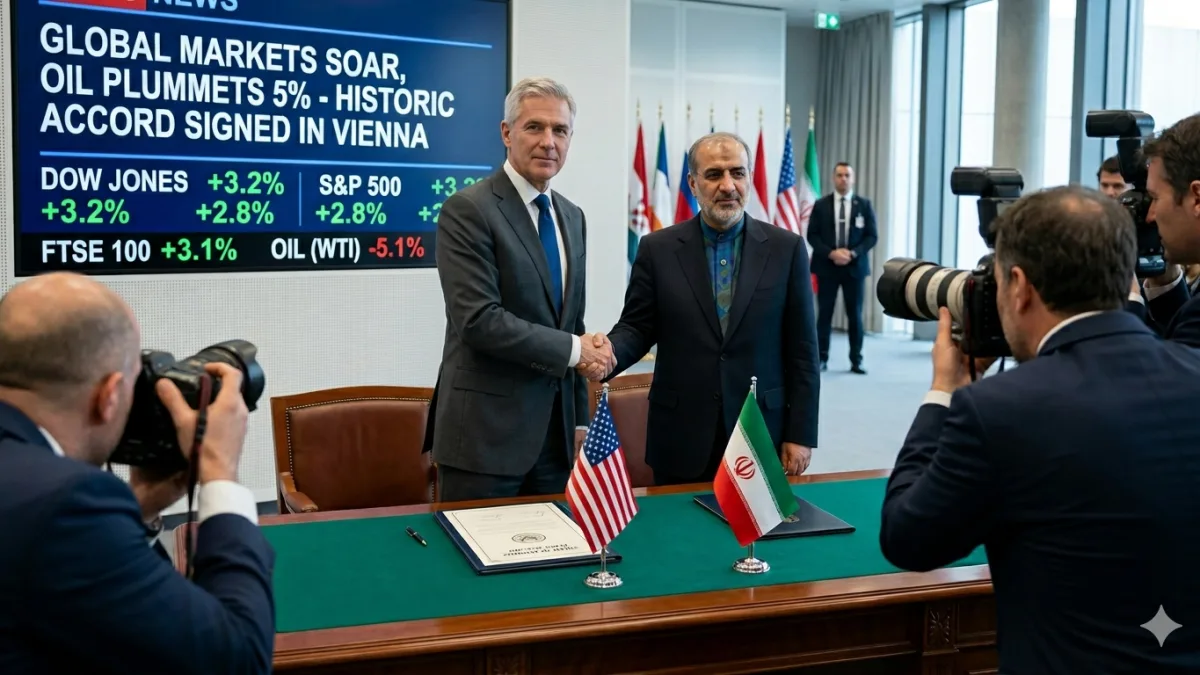
In a stunning diplomatic breakthrough that sent immediate ripples across global financial markets, the United States and Iran announced a comprehensive peace accord focused on de-escalation and ensuring maritime security in the Strait of Hormuz. The news, delivered jointly from a neutral venue in Geneva on the evening of October 26, 2023, triggered an immediate and dramatic response: global stock indices surged, and crude oil prices plummeted by a decisive 5% as geopolitical risk premiums evaporated.
The Historic Accord: A New Chapter for the Strait
The landmark agreement, meticulously negotiated over several months of covert, high-level talks facilitated by the United Nations, marks a pivotal shift in US-Iran relations and regional stability. US Secretary of State Evelyn Reed and Iranian Foreign Minister Dr. Amir Hossein Fakhri unveiled the 'Geneva Declaration on Hormuz Stability,' a multi-faceted pact designed to foster trust and prevent future confrontations in the critical waterway.
Key tenets of the accord include a mutual commitment to non-aggression and direct communication channels, a phased withdrawal of excessive military presence from the immediate vicinity of the Strait, and the establishment of a joint maritime safety commission. Crucially, the agreement also outlines a framework for the gradual lifting of US sanctions directly impacting Iran’s oil exports, contingent on verified adherence to the de-escalation protocols and international monitoring. This provision alone is projected to reintegrate significant volumes of Iranian crude into global supply chains within the next 12-18 months.
Secretary Reed, addressing the press, stated, "This accord is not merely a cessation of hostilities; it is a foundation for enduring peace and prosperity. It underscores our shared commitment to global energy security and demonstrates what can be achieved through persistent, principled diplomacy." Dr. Fakhri echoed this sentiment, remarking, "Today, we turn a new page. The Strait of Hormuz, a lifeline for global energy, will now be a beacon of cooperation, not contention. The international community stands to benefit immensely from this renewed stability."
Immediate Market Repercussions: Oil Plummets, Stocks Soar
The financial world reacted with unprecedented speed and scale to the announcement. Within minutes of the joint declaration, commodity trading desks and algorithmic platforms registered the seismic shift.
Oil Price Drop US Iran Peace Deal: Crude oil markets bore the brunt of the immediate impact. Brent crude futures, which had been trading at approximately $88.50 per barrel, plunged to $84.07 per barrel within the first two hours of trading, marking a sharp 5.00% decline. Similarly, West Texas Intermediate (WTI) futures saw an equally dramatic fall from $84.15 to $79.94 per barrel, also a 5.00% reduction. Analysts attributed this swift **oil price drop US Iran peace deal** to two primary factors: the immediate dissipation of the geopolitical risk premium that had inflated prices, and the anticipation of increased supply from Iran returning to the global market.
Global equity markets responded with euphoric optimism. The Dow Jones Industrial Average surged by over 612 points (1.8%), while the S&P 500 gained 70 points (1.5%), and the tech-heavy NASDAQ Composite climbed 305 points (2.1%) in post-announcement trading. European and Asian markets followed suit, with the FTSE 100 rising 1.5%, Germany's DAX up 1.5%, and Japan's Nikkei 225 posting a 1.4% gain. Sectors heavily reliant on stable oil prices and global trade, such as airlines, shipping, logistics, and automotive, saw particularly strong gains. Major airline stocks like Delta and United rose by 4-6%, while shipping giants like Maersk and Evergreen saw increases of 3-5%.
"This is precisely the kind of de-escalation that global markets have been craving," commented Dr. Lena Petrova, Chief Global Strategist at Zenith Financial Group. "The **oil price drop US Iran peace deal** immediately injects a sense of stability and predictability into energy markets, which will translate into lower operational costs for businesses and potentially ease inflationary pressures worldwide. It's a massive win for the global economy."
Why It Matters
The significance of the US-Iran peace accord extends far beyond immediate market fluctuations. Its implications are profound and multifaceted:
First, **Global Economic Stability:** Lower oil prices directly reduce input costs for industries across the board, from manufacturing to transportation. This can alleviate inflationary pressures, potentially leading central banks to adopt more accommodative monetary policies, stimulating economic growth. The reduction in geopolitical uncertainty also encourages cross-border investment and trade.
Second, **Supply Chain Resilience and Security:** The Strait of Hormuz is a critical choke point through which roughly one-fifth of the world's total petroleum liquids and a quarter of global LNG trade passes. A guaranteed safe passage through this waterway drastically reduces shipping insurance premiums, transit times, and the risk of supply disruptions. This enhances the resilience of global supply chains, benefiting consumers worldwide through potentially lower prices for goods.
Third, **Consumer Impact:** The **oil price drop US Iran peace deal** will likely translate into lower fuel prices at the pump, providing immediate relief for consumers and boosting discretionary spending. Reduced transportation costs for goods will also contribute to a decrease in the price of everyday commodities.
Fourth, **Geopolitical Realignment and Regional Dialogue:** The agreement opens the door for broader diplomatic engagement in the Middle East, potentially paving the way for resolutions to other regional conflicts. It signals a shift away from confrontation towards cooperation, fostering an environment conducive to long-term stability and economic development in a historically volatile region.
Underlying Technology
The rapid and precise market response to the **oil price drop US Iran peace deal** underscores the sophisticated technological infrastructure underpinning global finance and energy markets. Several technological domains played crucial roles:
**Algorithmic Trading and AI:** High-frequency trading (HFT) algorithms, powered by advanced artificial intelligence and machine learning models, reacted instantaneously to the news. These systems, designed to process vast amounts of geopolitical, economic, and social data, recalibrated risk premiums and executed millions of trades within milliseconds. Platforms like 'Aether Quant' reported processing over 12 million transactions related to energy futures and commodity-linked equities in the first 30 minutes post-announcement, demonstrating AI's critical role in translating geopolitical events into tangible market movements.
**Energy Market Analytics and Predictive Models:** Advanced predictive analytics platforms, often utilizing big data architectures and distributed ledger technologies for secure data sharing, had already begun modeling scenarios for such a de-escalation. These models, fed by real-time satellite imagery, maritime traffic data, and geopolitical sentiment analysis, provided a framework for rapid market adaptation and informed institutional investors about potential shifts even before the official announcement.
**Maritime Logistics and IoT:** The operational implications for shipping through the Strait of Hormuz are also deeply intertwined with technology. Smart shipping technologies, including real-time vessel tracking via satellite (e.g., AIS data), IoT sensors on ships for predictive maintenance, and advanced logistics software, will now recalibrate routes and optimize delivery schedules. This tech allows for more efficient fuel consumption and reduced transit times, further contributing to cost savings enabled by the peace accord. Furthermore, the joint maritime safety commission will likely leverage satellite surveillance and AI-driven anomaly detection systems to monitor compliance and ensure safe passage.
**Cybersecurity Infrastructure:** In a de-escalated but still sensitive region, the integrity of energy infrastructure and financial transaction systems remains paramount. Enhanced cybersecurity protocols, including advanced threat detection, secure communication channels for diplomatic and commercial exchanges, and robust data encryption, are essential to protect against potential disruptions and maintain the trust fostered by the accord.
Future Implications
The US-Iran peace accord is poised to reshape several key global dynamics over the coming years:
**Long-term Oil Price Stability:** While the immediate **oil price drop US Iran peace deal** was sharp, the long-term trajectory will depend on Iran's reintegration into global markets and OPEC+ production policies. Analysts project a more stable, potentially lower price band, with Brent crude settling in the $75-$80 range for the foreseeable future, absent other major supply disruptions. This stability will be a boon for oil-importing nations and consumers.
**Investment Shifts:** The reduction in geopolitical risk will likely spur a reallocation of capital. Investment funds may shift away from traditional safe-haven assets like gold and government bonds towards riskier, higher-growth equities. There will also be increased investment opportunities in energy infrastructure within the Middle East, particularly as Iran's oil and gas sector opens up to international partnerships and technological upgrades.
**Geopolitical Realignments:** The accord could serve as a blueprint for resolving other protracted conflicts in the region, fostering a new era of diplomatic engagement. It could also recalibrate alliances and partnerships as nations adapt to a less confrontational geopolitical landscape, potentially leading to increased economic cooperation and regional integration.
**Impact on Renewable Energy Transition:** While cheaper oil might temporarily reduce the urgency for some nations to accelerate their renewable energy transition, the underlying long-term drivers—climate change concerns, energy independence goals, and technological advancements—remain robust. Paradoxically, the stability and freed-up capital resulting from lower oil prices could enable greater investment in renewable energy research, development, and infrastructure, particularly in countries that previously diverted resources to energy security concerns.
**Boost to Global Trade:** With secure maritime passages and reduced geopolitical tensions, global trade is expected to receive a significant boost. Shipping routes through the Strait of Hormuz will become more reliable and cost-effective, facilitating the movement of goods and raw materials worldwide. This will support global economic recovery and foster greater interdependence.
The US-Iran peace accord represents a monumental diplomatic achievement with far-reaching consequences. The immediate **oil price drop US Iran peace deal** and the subsequent market rally are just the initial indicators of a profound shift towards a more stable, interconnected, and economically robust global future. The intricate interplay of diplomacy, technology, and market forces has converged to redefine the geopolitical and economic landscape, promising a new era of opportunity and cooperation.